Content Menu
● Understanding BS Standard Scaffolding Tube Thickness
>> What is BS Standard Scaffolding?
>> Key Specifications of BS Standard Scaffolding Tubes
>> Importance of BS Standard Compliance
● Why Accurate Measurement of Scaffolding Tube Thickness Matters
● Tools Required for Measuring BS Standard Scaffolding Tube Thickness
>> 1. Vernier Caliper
>> 2. Micrometer
>> 3. Ultrasonic Thickness Gauge
>> 4. Digital Calipers
>> 5. Other Tools
● Step-by-Step Guide to Measure BS Standard Scaffolding Tube Thickness Accurately
>> Step 1: Prepare the Tube
>> Step 2: Measure Outer Diameter
>> Step 3: Measure Inner Diameter
>> Step 4: Calculate Wall Thickness
>> Step 5: Use Micrometer for Direct Thickness Measurement
>> Step 6: Repeat Measurements
● Additional Considerations When Measuring BS Standard Scaffolding Tube Thickness
>> Material Type and Surface Coating
>> Environmental Factors
>> Tube Wear and Corrosion
>> Calibration of Measuring Instruments
>> Documentation and Reporting
● Summary Table: BS Standard Scaffolding Tube Thickness Specifications
● Conclusion
● FAQ
>> 1. What is the standard wall thickness for BS standard scaffolding tubes?
>> 2. How do I measure the wall thickness of a scaffolding tube without damaging it?
>> 3. Why is the outer diameter of scaffolding tubes standardized at 48.3 mm?
>> 4. Can I use a digital caliper to measure scaffolding tube thickness?
>> 5. What should I do if the measured thickness is outside the BS1139 tolerance?
Measuring the BS standard scaffolding tube thickness accurately is critical for ensuring the safety, durability, and compliance of scaffolding systems used in construction and industrial projects. The British Standard BS1139 defines strict requirements for scaffolding tubes, including their dimensions, material properties, and tolerances. This comprehensive guide will walk you through the importance of measuring tube thickness, the tools and methods to do so precisely, and the standards you need to comply with.
Understanding BS Standard Scaffolding Tube Thickness
What is BS Standard Scaffolding?
BS1139 is a British Standard that specifies the requirements for scaffolding tubes and components to ensure safety and performance. It covers dimensions, material quality, mechanical properties, and surface treatments for scaffolding tubes, clamps, and boards.
Key Specifications of BS Standard Scaffolding Tubes
- Outer Diameter: 48.3 mm (± 0.5 mm)
- Wall Thickness: Typically 3.2 mm, 3.6 mm, 3.8 mm, or 4.0 mm
- Material: Steel or hot-dip galvanized steel for corrosion resistance and durability
- Tolerance: Wall thickness tolerance is ±10% according to BS1139
The tube thickness directly affects the load-bearing capacity and longevity of the scaffolding system, making accurate measurement essential.
Importance of BS Standard Compliance
Adhering to BS1139 ensures that scaffolding components are compatible, reliable, and safe. Non-compliance can lead to structural failures, legal liabilities, and increased project costs. Therefore, accurate measurement of scaffolding tube thickness is not just a technical requirement but a critical safety measure.
Why Accurate Measurement of Scaffolding Tube Thickness Matters
- Safety: Ensures the scaffolding can support the required loads without failure.
- Compliance: Meets legal and industry standards to avoid penalties or accidents.
- Durability: Confirms corrosion resistance and mechanical strength.
- Cost Efficiency: Prevents overuse of materials or under-specification that could lead to costly repairs.
- Quality Control: Helps manufacturers and contractors maintain consistent product quality.
Accurate thickness measurement helps detect manufacturing defects such as uneven wall thickness, corrosion, or wear that could compromise scaffolding integrity.

Tools Required for Measuring BS Standard Scaffolding Tube Thickness
1. Vernier Caliper
A vernier caliper is a precise measuring instrument capable of measuring the external and internal diameters and thickness of tubes with an accuracy of up to 0.02 mm. It is widely used because of its versatility and affordability.
2. Micrometer
A micrometer screw gauge is ideal for measuring small thicknesses with high precision, especially useful for confirming wall thickness on cut samples or accessible tube sections.
3. Ultrasonic Thickness Gauge
For non-destructive testing, an ultrasonic thickness gauge can measure the tube wall thickness without damaging the scaffolding tube. This is especially useful for in-service inspections where cutting samples is not feasible.
4. Digital Calipers
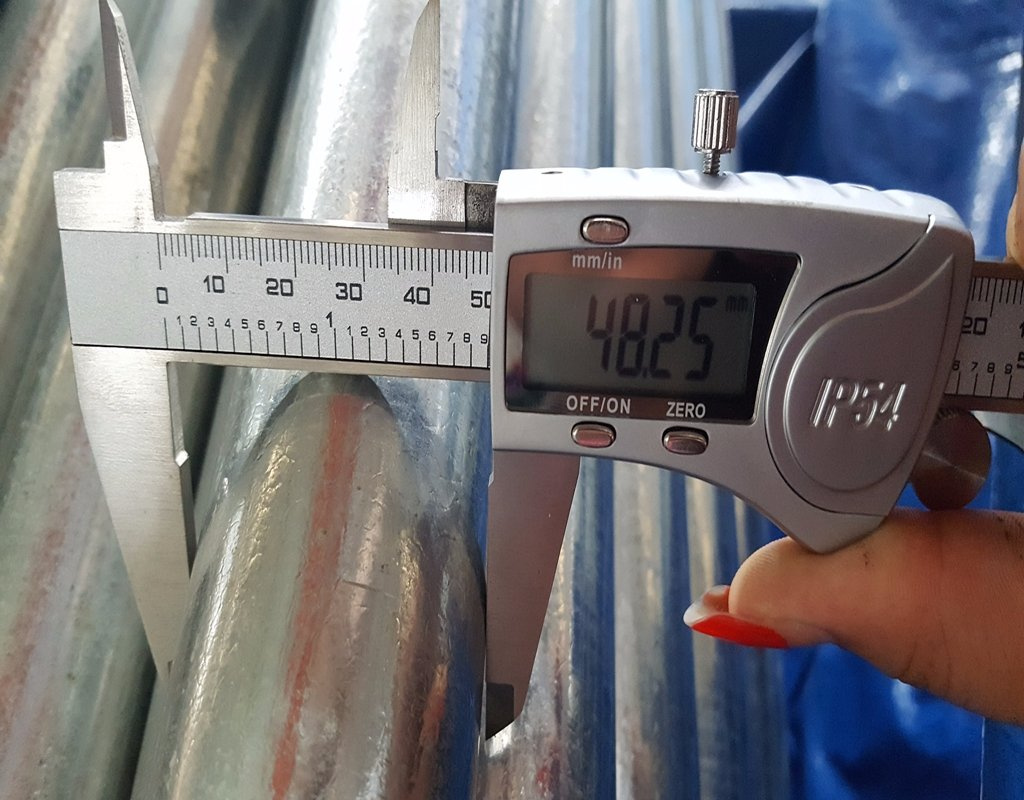
Digital calipers provide quick and easy readings with digital displays, reducing human error and improving measurement speed.
5. Other Tools
- Steel Ruler: For rough measurements.
- Tape Measure: To verify tube length.
- Surface Cleaner: To prepare the tube surface for accurate measurement.
Step-by-Step Guide to Measure BS Standard Scaffolding Tube Thickness Accurately
Step 1: Prepare the Tube
- Ensure the scaffolding tube surface is clean and free of rust, paint, or dirt.
- Use a wire brush or cloth to remove any surface contaminants.
- For galvanized tubes, avoid scratching the protective zinc coating.
Step 2: Measure Outer Diameter
- Use a vernier caliper or digital caliper.
- Place the caliper jaws around the tube's outer circumference.
- Take multiple measurements at different points along the tube to check for uniformity.
- The measurement should be close to 48.3 mm ± 0.5 mm as per BS1139.
Step 3: Measure Inner Diameter
- Use the internal jaws of the caliper to measure the inner diameter.
- This helps calculate the wall thickness by subtracting inner diameter from outer diameter.
- Take several readings to ensure consistency.
Step 4: Calculate Wall Thickness
- Wall Thickness = (Outer Diameter - Inner Diameter) / 2
- Compare the result with the standard thickness values (3.2 mm, 3.6 mm, 3.8 mm, or 4.0 mm).
- Confirm that the thickness falls within the ±10% tolerance.
Step 5: Use Micrometer for Direct Thickness Measurement
- For direct measurement of wall thickness, cut a small sample (if possible) and measure with a micrometer.
- Alternatively, use an ultrasonic thickness gauge for non-destructive measurement.
- Ensure the micrometer is calibrated for accurate readings.
Step 6: Repeat Measurements
- Take measurements at multiple points along the tube length to check for uniformity.
- The maximum deviation allowed is 3 mm per meter length for straightness and 0.002L for deflection, ensuring consistency.
- Document all measurements for quality control and traceability.
Additional Considerations When Measuring BS Standard Scaffolding Tube Thickness
Material Type and Surface Coating
Hot-dip galvanized steel tubes have a zinc coating that can slightly affect thickness readings. When using calipers or micrometers, the coating is included in the measurement. Ultrasonic gauges can be set to exclude coatings, providing more accurate steel thickness.
Environmental Factors
Temperature and humidity can affect measurement accuracy. Measure tubes in a controlled environment when possible, or apply temperature correction factors.
Tube Wear and Corrosion
Regular inspection is needed to detect corrosion or wear that reduces wall thickness over time. Ultrasonic thickness gauges are ideal for ongoing maintenance checks.
Calibration of Measuring Instruments
Regular calibration of vernier calipers, micrometers, and ultrasonic gauges is essential to maintain measurement accuracy and reliability.
Documentation and Reporting
Maintain detailed records of all measurements, including date, location, operator, and instrument used. This documentation supports quality assurance and compliance audits.
Summary Table: BS Standard Scaffolding Tube Thickness Specifications
| Parameter |
Specification |
| Outer Diameter |
48.3 mm ± 0.5 mm |
| Wall Thickness |
3.2 mm, 3.6 mm, 3.8 mm, 4.0 mm |
| Material |
Steel, Hot-dip Galvanized Steel |
| Thickness Tolerance |
± 10% |
| Length |
1m to 6m (varies) |
| Straightness Deviation |
≤ 3 mm per meter |
Conclusion
Accurately measuring the BS standard scaffolding tube thickness is essential for ensuring the safety, compliance, and durability of scaffolding systems. Using precise tools such as vernier calipers, micrometers, and ultrasonic thickness gauges, and following standardized measurement procedures, helps maintain quality control in scaffolding construction. Adhering to BS1139 standards not only guarantees structural integrity but also protects workers and projects from potential hazards. Regular inspection and measurement of scaffolding tubes should be an integral part of construction site safety protocols.
By implementing these measurement best practices, manufacturers and contractors can ensure their scaffolding assemblies meet the highest safety standards and perform reliably under demanding conditions.

FAQ
1. What is the standard wall thickness for BS standard scaffolding tubes?
The standard wall thicknesses are 3.2 mm, 3.6 mm, 3.8 mm, and 4.0 mm, with a tolerance of ±10% as per BS1139.
2. How do I measure the wall thickness of a scaffolding tube without damaging it?
Use an ultrasonic thickness gauge, which provides non-destructive measurement of the tube wall thickness.
3. Why is the outer diameter of scaffolding tubes standardized at 48.3 mm?
48.3 mm is the BS1139 standard outer diameter ensuring compatibility with couplers and fittings, and it corresponds to the old 1.5-inch nominal size.
4. Can I use a digital caliper to measure scaffolding tube thickness?
Yes, digital calipers are accurate and user-friendly tools suitable for measuring outer and inner diameters to calculate wall thickness.
5. What should I do if the measured thickness is outside the BS1139 tolerance?
If the thickness is outside ±10% tolerance, the tube should be rejected or replaced to ensure safety and compliance.