Content Menu
● Types of Scaffolding Systems
● Cuplock Scaffolding System
● Ringlock Scaffolding System
● Safety Features in Scaffolding Locking Systems
● Installation and Dismantling
● Conclusion
● FAQ
>> 1. What is the main difference between Cuplock and Ringlock scaffolding?
>> 2. Which scaffolding system is easier to install, Cuplock or Ringlock?
>> 3. Are Cuplock and Ringlock scaffolding systems safe?
>> 4. Can Cuplock and Ringlock scaffolding systems be used for any type of construction project?
>> 5. How often should scaffolding locking systems be inspected?
● Citations:
Scaffolding is a temporary structure erected to support workers and materials during the construction, repair, or cleaning of buildings and other large structures. A crucial aspect of scaffolding is the locking system, which ensures the stability and safety of the entire structure. Different types of scaffolding systems employ various locking mechanisms, each with its own advantages and applications. This article will delve into the workings of scaffolding locking systems, focusing on the popular Cuplock and Ringlock systems, their components, benefits, and safety features.
Types of Scaffolding Systems
Modular scaffolds can be segmented into the Cuplock system, the Ringlock system, and the Kwickstage system[1].
- Cuplock Scaffolding: This system is known for its unique locking mechanism, ease of use, and robustness[1].
- Ringlock Scaffolding: Considered one of the most sophisticated systems, Ringlock scaffolding is designed for easy installation and dismantling with a minimal number of components[4].
- Kwikstage Scaffolding: While not detailed in the provided search results, Kwikstage is another type of modular scaffolding system commonly used in the construction industry.
Cuplock Scaffolding System
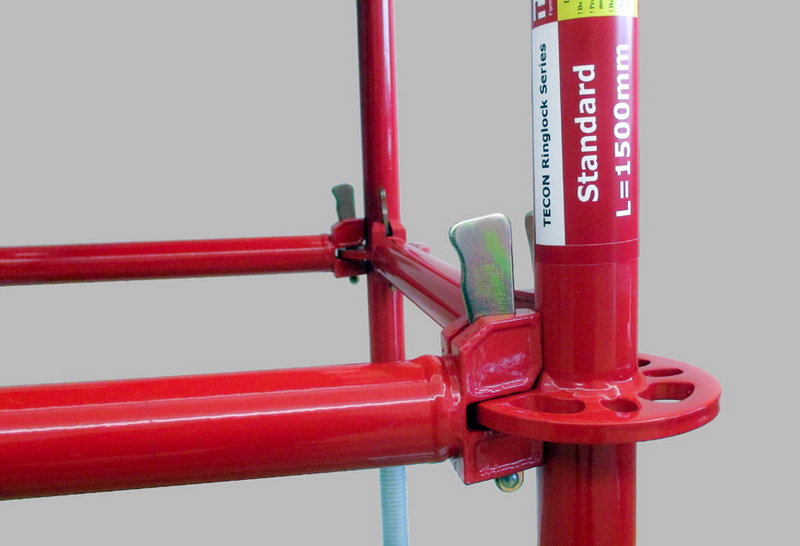
The Cuplock scaffolding system is a modular system characterized by a unique locking mechanism that connects four horizontal members to a vertical standard in a single action[1]. This system is widely used due to its simplicity, speed of erection, and adaptability to various applications[9].
Components of a Cuplock System:
- Standards (Verticals): Vertical tubes that provide the main support for the scaffolding structure.
- Ledgers (Horizontals): Horizontal tubes that connect to the standards and provide support for the working platform.
- Transoms: Shorter horizontal tubes that span between ledgers to provide additional support for the platform.
- Cups: These are located at fixed intervals on the standards. There are two cups – a fixed lower cup and a sliding upper cup.
- Blades: The ends of the ledgers and transoms have blade-like fittings that locate into the lower cup.
- Guardrails: Vertical posts that act as a barrier to prevent falls.
- Base Jacks: Adjustable bases to level the scaffold on uneven ground.
- Tie Bars: Connect brackets at each end of the platform[2].
How the Cuplock System Works:
1. Erection: The standards are first placed vertically on adjustable base jacks to ensure a level base[2].
2. Ledger and Transom Connection: The blades at the ends of the ledgers and transoms are inserted into the fixed lower cup on the standard[9].
3. Locking: The upper cup is then slid down and rotated to lock the ledgers and transoms in place. This creates a strong and secure connection[1].
4. Platform Installation: Once the ledgers and transoms are secured, planks or platforms are placed on top to create a working surface[2].
5. Bracing: Diagonal braces can be added to increase the stability of the scaffold[9].
6. Adding Height: Additional standards are added on top of the existing ones, and the process is repeated to achieve the desired height[2].
Advantages of Cuplock Scaffolding:
- Speed of Erection: The simple locking mechanism allows for quick and easy assembly, saving time and labor costs[9].
- Flexibility: The system can be easily adapted to various shapes and sizes, making it suitable for a wide range of applications[9].
- Strength and Stability: The robust design and secure locking mechanism ensure a stable and safe working platform[9].
- Safety: Cuplock scaffolding removes diagonal bracing obstructions common in traditional scaffolding, keeping work platforms continuous and safer to navigate[9].
Ringlock Scaffolding System
The Ringlock system is another type of modular scaffolding known for its versatility, high load-bearing capacity, and safety features[4]. It is widely used in construction, maintenance, and event staging.
Components of a Ringlock System:
- Standards (Verticals): Similar to Cuplock, these are the vertical supports of the scaffold.
- Ledgers (Horizontals): Horizontal members that connect to the standards.
- Transoms: Provide additional support for the working platform.
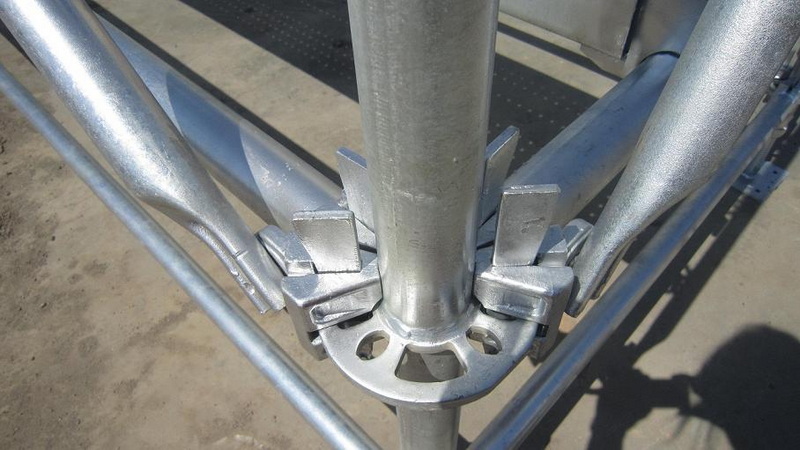
- Rosettes: These are circular plates welded to the standards at fixed intervals. They have multiple openings (usually eight) to accommodate ledgers and transoms at various angles[4].
- Wedges: Used to lock the ledgers and transoms into the rosette[10].
- Guardrails: Vertical posts that act as a barrier to prevent falls[7].
- Base Jacks: Adjustable bases to level the scaffold[2].
How the Ringlock System Works:
1. Erection: Standards are placed vertically and leveled using adjustable base jacks[2].
2. Ledger and Transom Connection: The ledgers and transoms are connected to the rosettes on the standards. The ends of the ledgers and transoms have wedge pins that fit into the openings on the rosette[10].
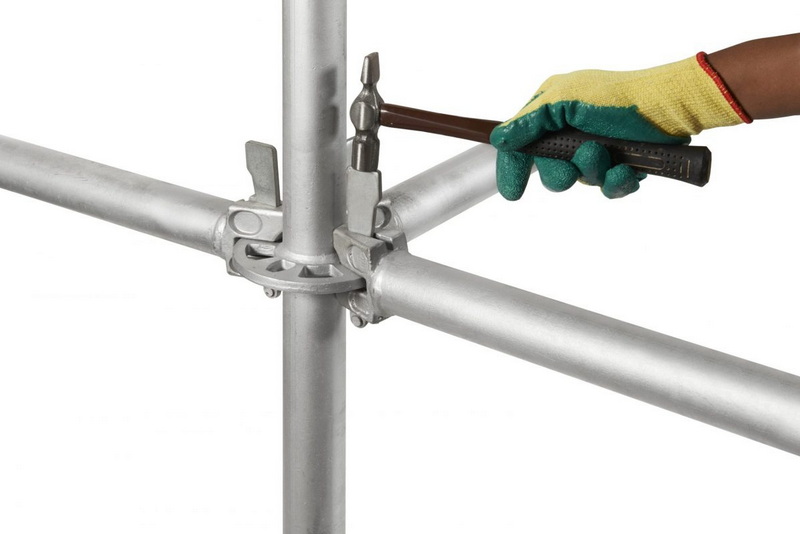
3. Locking: The wedges are hammered into place, securing the ledgers and transoms to the standard. The rosette design allows for connections at multiple angles, providing greater flexibility in scaffold design[10].
4. Platform Installation: Planks or platforms are placed on top of the transoms to create a working surface[2].
5. Bracing: Diagonal braces are added for increased stability[2].
6. Adding Height: Additional standards are added, and the process is repeated to achieve the desired height[2].
Advantages of Ringlock Scaffolding:
- Versatility: The rosette design allows for connections at various angles, making it adaptable to complex structures[10].
- High Load-Bearing Capacity: Ringlock systems are designed to handle heavy loads, making them suitable for demanding construction projects[4].
- Safety: The secure wedge connections and the availability of guardrails and toe boards enhance worker safety[7].
- Speed of Erection: While perhaps not as fast as Cuplock in some situations, Ringlock systems are still relatively quick to assemble due to the simple wedge locking mechanism[7].
Safety Features in Scaffolding Locking Systems
Safety is paramount in scaffolding, and locking systems play a critical role in ensuring a safe working environment[7].
Common Safety Features:
- Secure Connections: Both Cuplock and Ringlock systems use robust locking mechanisms to prevent accidental disconnections[7].
- Guardrails and Toe Boards: These are essential components that provide fall protection on all working platforms and access points[7].
- Bracing: Diagonal and horizontal bracing adds stability to the scaffold structure, preventing sway and collapse[2].
- Load Capacity: Scaffolding systems are designed to handle specific loads. It is crucial to adhere to these limits to prevent overloading and potential failure[4].
- Regular Inspections: Regular inspections of the scaffolding and its locking systems are necessary to identify and address any potential issues[2].
- Certified Components: Using standardized and certified scaffolding components ensures reliability and safety[7].
Installation and Dismantling
Cuplock System:
1. Place the standards (vertical posts) on a level surface and adjust the base jacks if necessary.
2. Insert the ledger blades into the lower cups on the standards.
3. Slide the upper cups down to secure the ledgers, ensuring they are tightly locked.
4. Add transoms between the ledgers for extra platform support.
5. Install guardrails and toe boards for safety.
6. Use diagonal braces for additional stability.
7. Repeat the steps to add more levels, ensuring each connection is secure.
8. To dismantle, reverse the process, starting from the top level.
Ringlock System:
1. Position the standards (vertical posts) on a stable base, adjusting the base jacks as needed.
2. Insert the ledger ends into the rosettes on the standards.
3. Hammer the wedges into the rosette openings to lock the ledgers in place.
4. Add transoms for platform support and secure them with wedges.
5. Install guardrails and toe boards for fall protection.
6. Use diagonal braces for increased stability.
7. Continue adding levels by repeating the process, ensuring all connections are locked.
8. To dismantle, remove the wedges and reverse the process, starting from the top level.
Conclusion
Scaffolding locking systems are essential for ensuring the safety and stability of temporary structures used in construction and other industries. The Cuplock and Ringlock systems are two popular choices, each offering unique advantages in terms of ease of use, flexibility, and load-bearing capacity. By understanding the components, working principles, and safety features of these systems, construction professionals can create safer and more efficient working environments. Regular inspections, proper training, and adherence to safety guidelines are crucial for preventing accidents and ensuring the well-being of workers on scaffolding structures.
FAQ
1. What is the main difference between Cuplock and Ringlock scaffolding?
The primary difference lies in their locking mechanisms. Cuplock uses a cup system where horizontal ledgers are secured by sliding and rotating an upper cup[1]. Ringlock, on the other hand, utilizes rosettes with multiple openings and wedge pins to lock the ledgers in place[10]. Ringlock offers more connection points and greater flexibility in angle adjustments compared to Cuplock[10].
2. Which scaffolding system is easier to install, Cuplock or Ringlock?
Cuplock is often considered faster to erect due to its simple cup locking mechanism[9]. Ringlock, while still relatively quick, may require slightly more time due to the need to hammer in the wedges for each connection[7]. The ease of installation can also depend on the specific application and the experience of the workers[9].
3. Are Cuplock and Ringlock scaffolding systems safe?
Yes, both Cuplock and Ringlock systems are designed with safety in mind[7]. They incorporate features such as secure locking mechanisms, guardrails, toe boards, and bracing to prevent falls and ensure stability[7]. Regular inspections and adherence to safety guidelines are crucial for maintaining a safe working environment[2].
4. Can Cuplock and Ringlock scaffolding systems be used for any type of construction project?
Both systems are versatile and can be adapted to various construction projects[9][4]. However, Ringlock is often preferred for projects requiring higher load-bearing capacity and more complex designs due to its greater flexibility in connections[4][10]. Cuplock is suitable for projects where speed of erection and simplicity are prioritized[9].
5. How often should scaffolding locking systems be inspected?
Scaffolding locking systems should be inspected regularly, ideally before each shift and after any event that could affect their integrity, such as severe weather or heavy impact[2]. Inspections should be carried out by competent personnel who can identify and address any potential issues, such as damaged components or loose connections[2].
Citations:
[1] https://aaitscaffold.com/cuplock-scaffolding/everything-about-cuplock-scaffolding-system/
[2] https://www.youtube.com/watch?v=veF4uSUtrEY
[3] https://patents.google.com/patent/CN102264992A/zh
[4] https://www.himoverseas.com/blog/an-overall-description-of-a-scaffolding-ring-lock-system_7526.htm
[5] https://www.youtube.com/watch?v=2t8lR3UOB6w
[6] https://www.labour.gov.hk/eng/public/os/B/mss.pdf
[7] https://dss.net/top-5-benefits-of-ring-lock-scaffolding-systems/
[8] https://www.youtube.com/watch?v=TLTqU1Jce2k
[9] https://www.internationalscaffolding.com/projects/what-is-a-cuplock-scaffolding-system/
[10] https://www.avontus.com/blog/introduction-to-system-scaffolding-design-and-safety/